Our planet is home to countless majestic trees, each with its own character and presence. The Bower itself is home to more than a few. But among all these trees, the one that looms largest in my memory is from my birthplace, far to the south of these White Mountains.
That tree was a banyan.
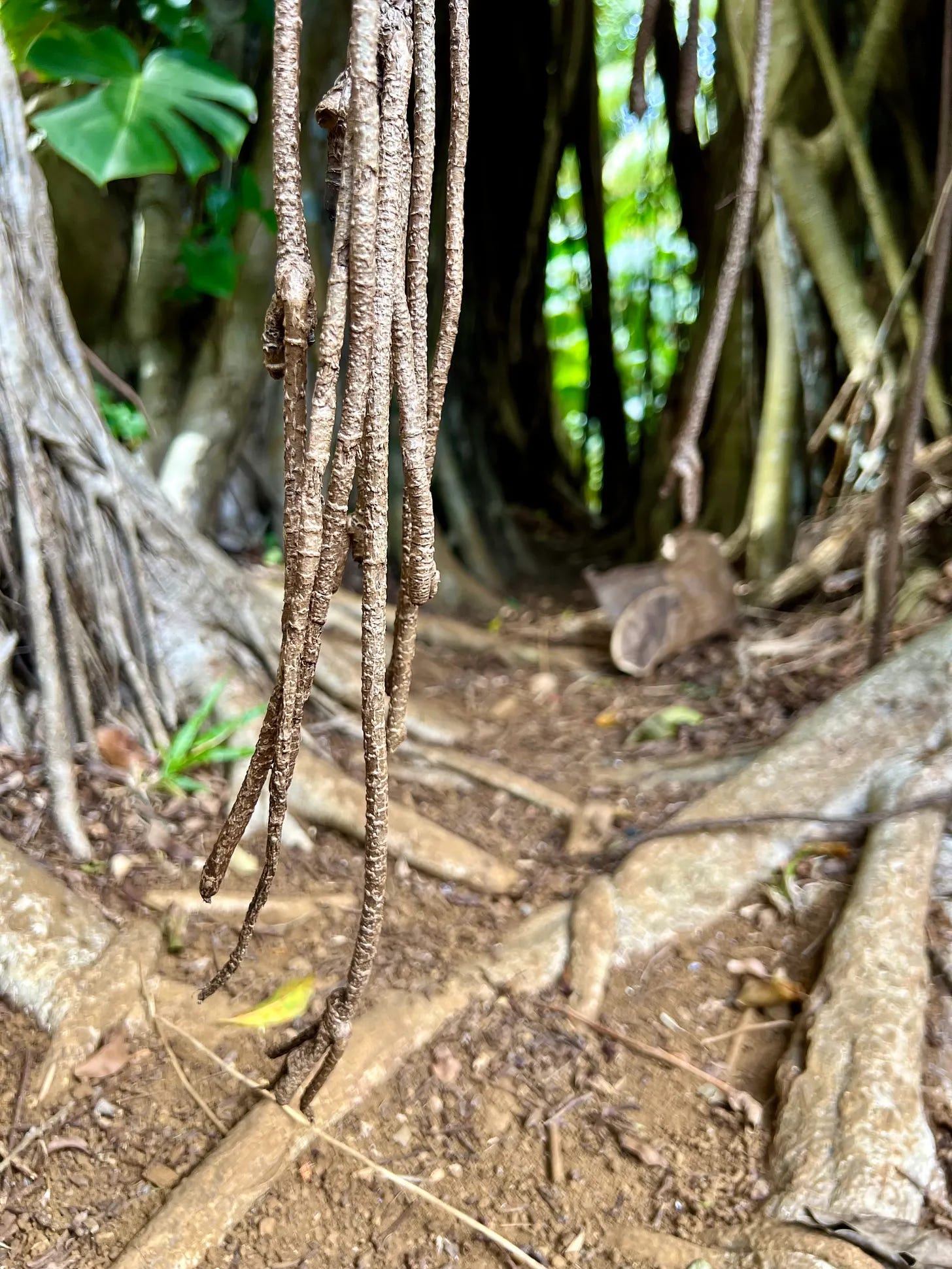
The first time you meet a mature banyan tree, you’ll be struck by its shaggy, primordial appearance and its staggering size—the woolly mammoth of the plant kingdom. The banyan’s distinctive appearance comes from the aerial roots that descend from its branches. These fibrous woody tresses hang down from the tree’s perimeter, stretching toward the earth. When at last they touch the ground, the roots burrow into the soil and grow into new trunks. In this way, the crown of a single banyan shades an entire forest in miniature.
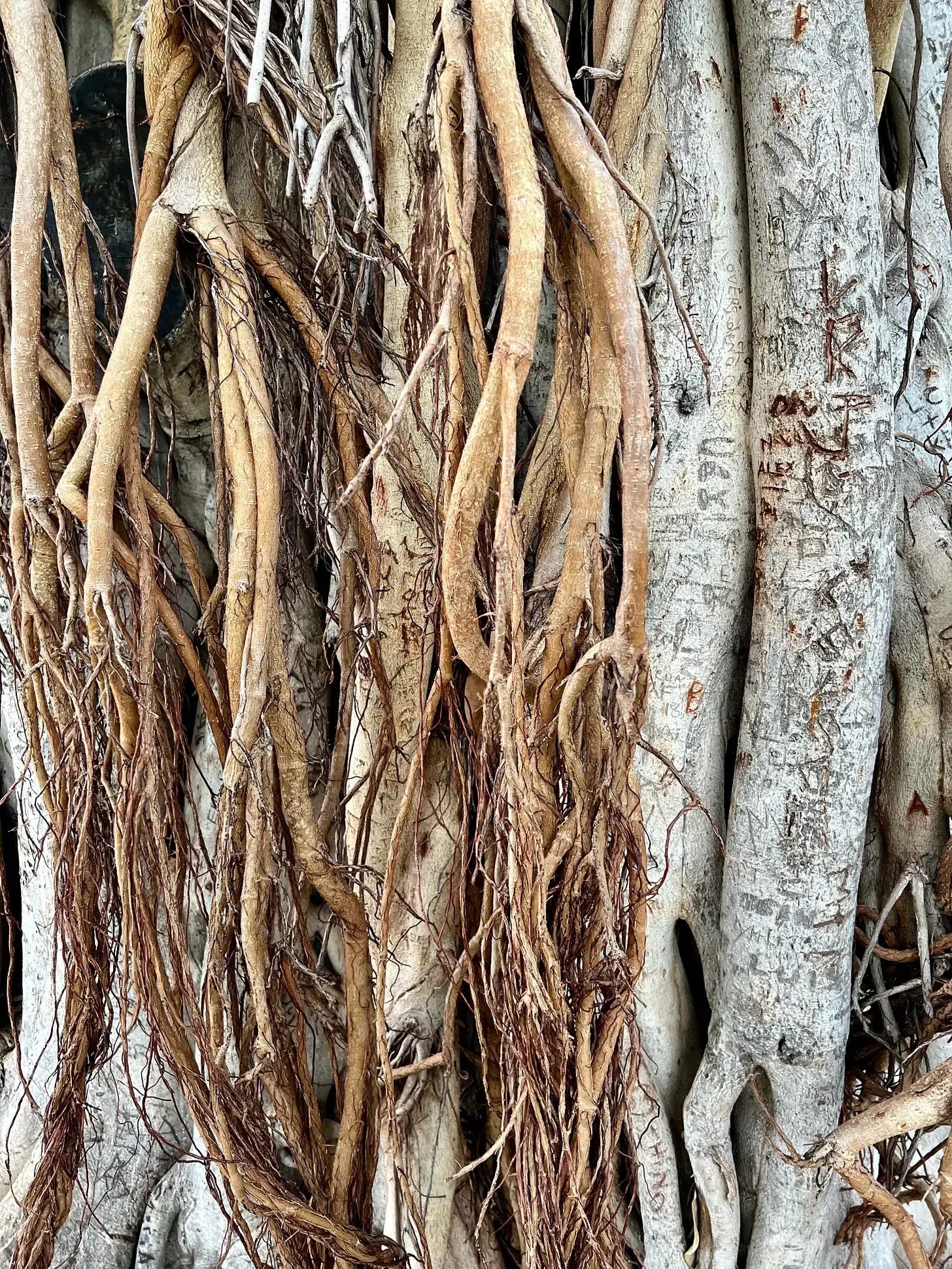
When I was a little girl, an enormous banyan tree—easily ten feet across at the base—grew on an empty lot just down the street from my house. I loved nothing more than to visit my banyan tree on a hot day to play inside the cool, shady maze formed by the gaps between its many trunks.
When I was five years old, a land developer purchased that empty lot to build a high-rise condominium and cut down the banyan tree to prepare for construction. Removing a tree that huge is no small feat; after the work was done, the stump left behind was still over six feet tall.
The banyan stump remained standing on the lot for over two years while the developer laid the groundwork for the high-rise. During that time, I would sneak onto the construction site to visit the stump and play inside of it, like I used to do when it was still a whole tree. With the upper section of the tree gone, I could climb up through the tunnels inside the stump and stand on its flat top. The cut surface of the stump was the size of a room, with a still-living tuft of leafy branches growing on one side—the perfect place to hide from nosy adults who might try to evict me from my banyan. I felt at peace when I was with that tree, even when all that remained was its stump.
I grew up and moved away, but that first relationship with a tree left a deep impression on me. Over the decades, as I lived and worked in urban environments all over the United States, I rarely felt so at peace as I had felt with that tree. Only when I was in natural spaces—especially in the forests of northern New England, where my extended family gathers most summers—did I feel at ease, calm, connected to nature. Living in urban areas, I often felt like I was holding my breath. Getting away from the cities, especially through camping trips to the national forests, gave me space to breathe. It was clear to me even as a young adult that, for my own well-being, I would eventually need to find a way to live closer to the forest.
I had been searching for a rural homestead for almost fifteen years when the Covid lockdowns began in March 2020. Living in lockdown in a dense city was incredibly stressful—a time of intense disconnection, confusion, and grief. Even so, I’m grateful for the crucible of that experience, because it forced me to focus single-mindedly on my search for land.
I packed up my car and left the city in May 2020, headed for northern New England with a plan to visit a number of rural properties for sale in the area around my family’s summer gathering spot. In June, a forest farm came on the market in the very town where I was renting a short-term Airbnb. I was enchanted by the final words of the property listing: “Here you will find peace. Owned, nurtured and loved by active conservationists for 50 years, Pine Knob Farm now seeks its Next Good Steward.”
I was pretty sure there was a typo in the listing, though. It couldn’t possibly be 913 acres of forest, could it? Probably just 9.13 acres … maybe 91.3? If I’d known how big this place is, I might have been too intimidated even to visit in the first place. The largest piece of land I’d ever been responsible for until that point was one fifth of an acre, and that had felt like plenty.
I will never forget what it felt like the day I set foot on this land for the first time. As I drove down the mile-long gravel lane through the shady tunnel of sugar maples that leads to the forest meadow surrounding the ruin of the original Bower farmhouse, it was love at first sight. I was coming home.
The love that’s been invested into this place over generations is palpable when you’re here. I’ve lived here for six years now, learning the role of land steward piece by piece. My co-stewards are many. The mentorship of Tanya Tellman; the practical advice of my neighbors who grew up walking, hunting, and exploring this land; the expert guidance of consulting foresters; the co-stewardship of the New England Forestry Foundation; and so much more has been part of my education. Above all, simply living here, caring for the land day by day, lets me experience firsthand how the land cares for me, and for all the creatures living here. Every stand of trees in this forest tells a story about growth and healing on the land, from the old growth stands to the regenerating young forest. It’s a story that extends back further than the Tellmans’ stewardship, and that I hope will stretch far beyond my own.
I knew as soon as I began to experience the healing energy of this place that I wanted to share it with other people. So I’ve spent a lot of time evaluating ways to open up to visitors the experience of being here, in ways that are light on the land and compatible with our forest conservation values. I discovered the Association of Nature & Forest Therapy (ANFT) while researching novel ways to bring people into relationship with nature for recreation, education, and healing. As I listened to the experiences of those in the ANFT community who have benefited from guided forest therapy, I was excited to make The Bower a space where this healing practice can take place.
After a year of collaboration with ANFT to design the forest therapy trail loop at The Bower, I’m pleased to announce that we are as of today New England’s very first ANFT-certified forest therapy trail. I expect we’ll be the first of many, as the powerfully positive effects of guided forest therapy become more widely known in our community.
I invite you to learn more about the new forest therapy trail here on our website, and to read ANFT’s blog post announcing that The Bower has joined their worldwide network of certified Trails, Spaces, and Places.
I hope you’ll have a chance to visit our new trail at The Bower, and I invite you to join us for the trail launch celebration at The Life Forest Midnight Market 2026—a community event taking place right here at the trailhead the evenings of September 25th and 26th.
Happy trails!